Lessons from Wrexham — No. 1
Most founders can describe their business. Far fewer can describe what it’s for.
Stop for a second and answer this question before you read another word.
What is your business actually for? Not what it does. Not what it sells. Not the problem it solves. What does it make possible for the people it touches? Who is genuinely better because you exist?
If you hesitated, keep reading. If you answered immediately and confidently, keep reading anyway, because there is a good chance the answer you gave was the polished version, not the true one.
The documentary that reframed how I see business
I have been a lawyer and a business owner for over thirty years. I have built firms, created opportunities for people, and watched colleagues come through my doors, grow, and move on to bigger things. For most of that time, I believed I knew what I was building. Then I watched a documentary about a Welsh football club and realized I had been answering the wrong question for most of my career.
The documentary is Welcome to Wrexham. You may have seen it. If you haven’t, the premise sounds like a joke. Two Hollywood actors, Rob McElhenney and Ryan Reynolds, decide to buy a struggling football club in a small working-class town in northern Wales. What it actually is, underneath the celebrity and the sport, is one of the most precise studies in business purpose, community trust, and leadership under pressure I have come across in years. I found it by accident on a Tuesday night with nothing else to do.
The business question most founders avoid
Here is the moment that stopped me.
Before Rob and Ryan could buy Wrexham AFC, the community that owned the club had to vote on whether to let them in. These were outsiders. Nobody in Wrexham knew them beyond their film credits. The community had every reason to be skeptical, and most of them were. So Rob and Ryan flew to Wales, stood in front of the people whose club they wanted to buy, and had to answer the question that every founder, every buyer, every leader eventually faces.
Why should we trust you with something that matters to us?
They didn’t answer with money. They didn’t answer with their names. They answered with a vision the community could see themselves inside. They wanted to take Wrexham from the lowest rungs of English football all the way to the Premier League. Four promotions. A climb almost nobody believed was realistic. And they framed the entire thing around what that journey would mean for the town, not for the owners.
They weren’t selling ownership. They were inviting belief. Ninety-five percent of the community voted yes.
Think about what it takes to get ninety-five percent of skeptical people to say yes to something. Most businesses can’t get that number from their own employees on a good day. The difference wasn’t charisma. It was clarity of purpose. They knew exactly what they were building, and they could say it in a way that made other people want to be part of it.
When I learned this lesson the hard way
I watched that scene and felt something I wasn’t expecting. Not admiration. Recognition. I have stood before juries, clients, and rooms full of skeptical people for 30 years, trying to do the same thing. And I have won plenty of those rooms.
But in 2009, I lost one I didn’t see coming, and it cost me more than I want to admit here.
My law partner and I had built the firm together from nothing. We started in alignment, which is the word people use when they mean they haven’t disagreed about anything important yet. We agreed on the cases we wanted, the clients we’d take, and the direction we were headed. That lasted until the firm actually began to succeed, when the real differences emerged. She wanted to go deep in one area of law and build there. I wanted to grow the firm broader and faster. Neither of us was wrong. We were just no longer building the same thing.
The partnership ended. So did the years of work we had built together. And the part that stayed with me wasn’t the split itself. It was the realization that we had never actually defined what we were building beyond the business. We knew what the firm did. We had never agreed on what it was for. When that question finally forced its way into the room, we didn’t have an answer we shared, and there was nothing to hold us together.
That is a different kind of loss than losing a case. It’s the kind that makes you go back and audit every decision you made along the way.
Why your outcome matters more than your business model
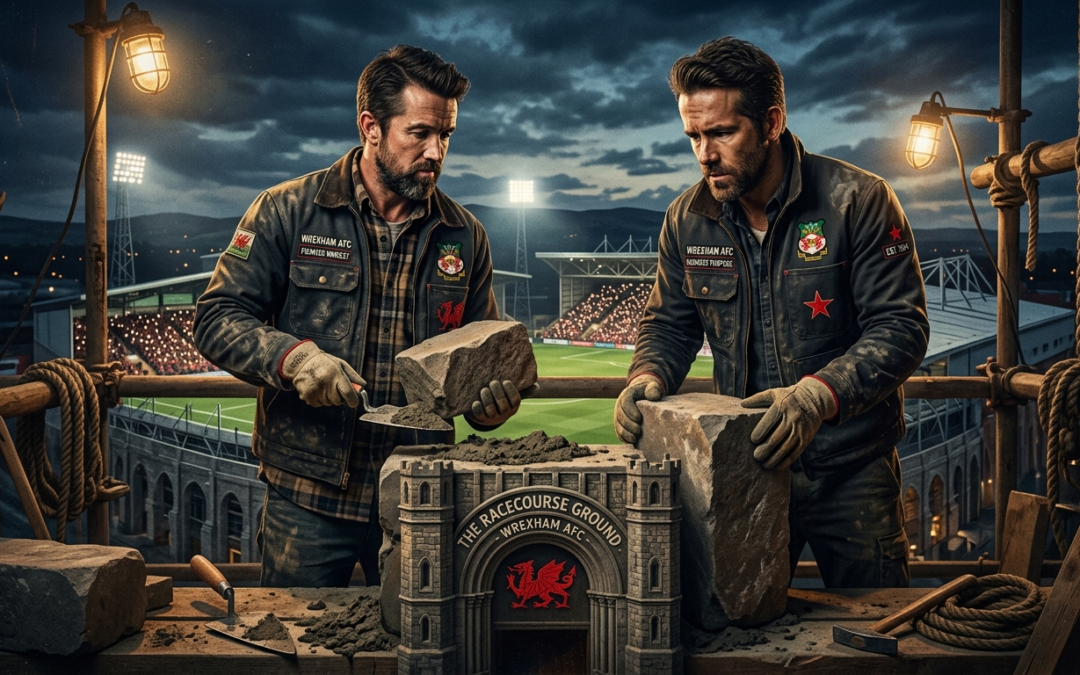
Simon Sinek tells a story about three bricklayers. Someone asks each of them what they are doing. The first says he is laying bricks. The second says he is building a wall. The third says he is building a cathedral. Same work. Same bricks. Completely different relationship to the work and to the people doing it alongside them.
What Rob and Ryan understood about Wrexham was that they were not in the football business. They were in the community revival business. The football club was the mechanism. The outcome was restoring belief in a place that had lost it. That clarity didn’t make the climb easier. What it did was make every hard decision easier to navigate, because they always had something larger to measure against. When you know what you’re building, you know what you can’t compromise on. That’s not inspiration. That’s leverage.
When you start with the business, you measure success by what the business produces.
When you start with the outcome, you measure success by what changes because you exist.
Those are two different games. Only one builds something people stay for.
A law firm that knows it exists to give people clarity when their lives feel uncertain makes different decisions than one that exists to bill hours. A crisis strategy firm that knows it exists to restore trust makes different decisions than one that exists to manage headlines. A youth hockey program that knows it exists to make kids fall in love with the game makes different decisions than one that exists to fill ice time. The outcome underneath the business is not a mission statement. It is the operating system. Everything runs on it, whether you’ve defined it or not.
Where this leaves me, and what it means for you
I’ll tell you where I am with this honestly.
I have spent thirty years laying good bricks. I have built structures that worked and helped people and created real opportunities. I do not regret any of it. But I am also sitting with the fact that I have not always known what the cathedral was supposed to be, and there were moments in my career where that cost me. The partnership. Decisions I made about growth that turned out to be about the business rather than about the outcome. Time spent optimizing things that were pointed in the wrong direction.
Watching Wrexham didn’t give me the answer. It gave me a sharper version of the question. And I think that question is worth more than most of the business advice I have consumed in the last decade.
What are you building, and who gets to believe in it besides you?
Because here is what nobody tells you about clarity of purpose. It doesn’t make things easier. It makes the wrong things harder to justify. You can’t take the client who doesn’t fit, or keep the partner who’s pointed elsewhere, or say yes to the opportunity that pays well but pulls you sideways once you know what you’re actually building. Clarity is demanding. But it is the only thing that keeps a business from becoming just a series of decisions made under pressure with no common thread running through them.
Rob and Ryan walked into Wrexham knowing what they were building. That’s why ninety-five percent of a skeptical community said yes. That’s why the show exists. That’s why you’re still reading this.
So go back to the question at the top of this page.
Answer it again. Slower this time.
ABOUT THIS SERIES
Lessons from Wrexham is a series that takes moments from Welcome to Wrexham and connects them to what actually matters in business, law, and leadership. Each piece comes with a question you have to answer and a decision you have to make. That is the commitment.
NEXT IN THE SERIES
Episode 2 — Alignment Is Not a Starting Point
Rob and Ryan chose each other as partners. Andy’s 2007 law firm partnership started in alignment and drifted apart. The lesson most business owners learn too late.